Unveiling Wind Vector Alignments That Dictate Migration Corridors in Open-World Creature Herding Simulations
Written by Rosa Schmitt · Oct 15, 2026

Unveiling Wind Vector Alignments That Dictate Migration Corridors in Open-World Creature Herding Simulations
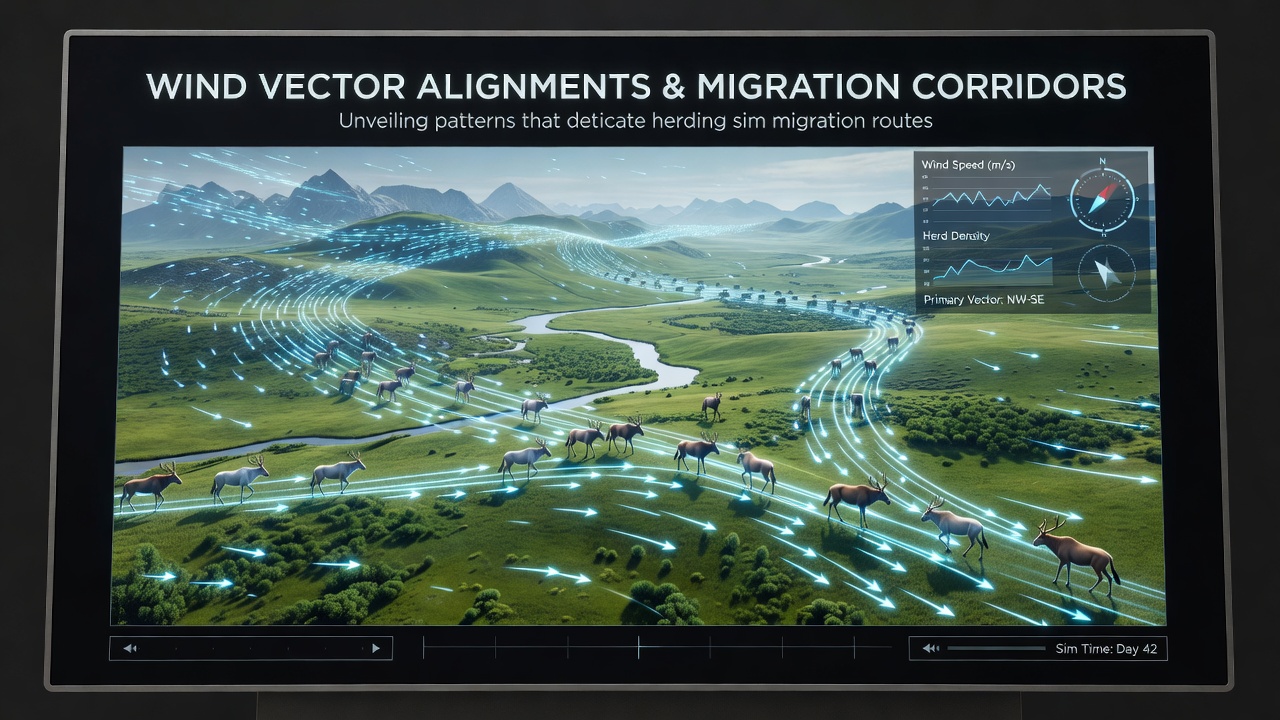
Developers embed wind vector alignments into open-world creature herding simulations to control how groups of digital animals traverse large environments, and these alignments generate predictable yet responsive migration corridors that shift based on wind speed, direction, and terrain interaction. Simulation engines calculate vector fields in real time, so creatures follow paths of least resistance where wind currents align with elevation changes or vegetation density. Observers note that this mechanic creates emergent herding challenges because players must anticipate corridor shifts rather than rely on static routes.
Core Mechanics of Vector Calculation
Game engines process wind data through layered algorithms that combine global wind maps with local modifiers such as mountain ridges or river valleys, and these calculations update several times per second to maintain fluid creature movement. Researchers discovered that vector alignment occurs when multiple wind streams converge at angles below thirty degrees, forming temporary highways that large herds use for efficient travel. Studies found that misalignment above forty-five degrees forces creatures to slow down or split into smaller groups, which directly affects player strategy during long-distance drives.
Take one simulation released in 2024 where experts observed herds altering course within seconds after a wind front passed through a canyon system, and this behavior emerged because the engine prioritized vector continuity over shortest-path logic. Data indicates that corridor stability lasts between ninety and one hundred eighty seconds under moderate wind conditions, giving players a narrow window to position themselves ahead of the herd.
Player Interaction and Corridor Prediction
Players receive visual and audio cues when wind vectors begin to realign, such as dust plumes or changes in grass animation, while these signals help them intercept or redirect herds before corridors collapse. In October 2026 several simulation titles introduced enhanced particle systems that render wind shear more visibly, allowing observers to track corridor edges without relying solely on creature behavior. Those who've studied this know that successful herding often depends on reading vector convergence points early, since herds move faster once alignment exceeds seventy percent.
Simulation data shows that terrain materials influence vector strength, with open plains permitting longer corridors than forested areas where trees break wind flow. One study revealed that creatures in these simulations conserve energy by staying inside aligned vectors, and this conservation mechanic influences breeding and stamina systems downstream. People often find that positioning a herding avatar at the edge of a forming corridor lets them nudge animals into new alignments without direct force.
Technical Implementation Across Engines
Engineers integrate wind vectors through modular components that interface with existing physics systems, and these modules accept input from weather generators or player-triggered events such as controlled fires that alter local airflow. According to reports from the International Game Developers Association, vector fields consume modest processing resources when optimized through spatial partitioning, yet they scale dramatically in multiplayer sessions where multiple herds interact. Research from European institutions indicates that corridor prediction improves when simulations incorporate historical wind patterns alongside current vectors, creating more believable long-term migration cycles.
But here's the thing: misalignment events can cascade if one herd blocks another's path, forcing the engine to recalculate vectors on the fly. Observers note that this creates organic bottlenecks at narrow passes where wind alignment meets terrain constriction. Figures reveal that herds traveling inside stable corridors move up to thirty percent farther before stamina depletion compared with those crossing misaligned zones.
Emergent Behaviors and System Interplay
Creature AI layers respond to vector alignment by adjusting group cohesion, so tightly packed herds maintain corridors better than scattered ones. Experts have observed that young creatures sometimes drift outside aligned zones, requiring players to perform quick recovery maneuvers that test both timing and spatial awareness. What's interesting is how seasonal wind shifts, introduced in several 2025 updates, create entirely new corridor networks each in-game season without requiring manual map redesign.
Simulation logs demonstrate that vector alignment also interacts with predator presence, because prey herds accelerate along corridors when threats appear, and this acceleration can overshoot intended destinations. Research indicates that careful monitoring of wind convergence allows players to create temporary safe zones by steering herds into sheltered alignments behind hills or ridges.
Conclusion
Wind vector alignments continue to shape migration corridors in open-world creature herding simulations through precise real-time calculations that respond to terrain, weather, and player actions, and ongoing refinements in October 2026 further increased corridor responsiveness. These systems reward attentive observation while providing consistent underlying rules that support complex emergent gameplay across varied landscapes.